Eurybia furcata
About
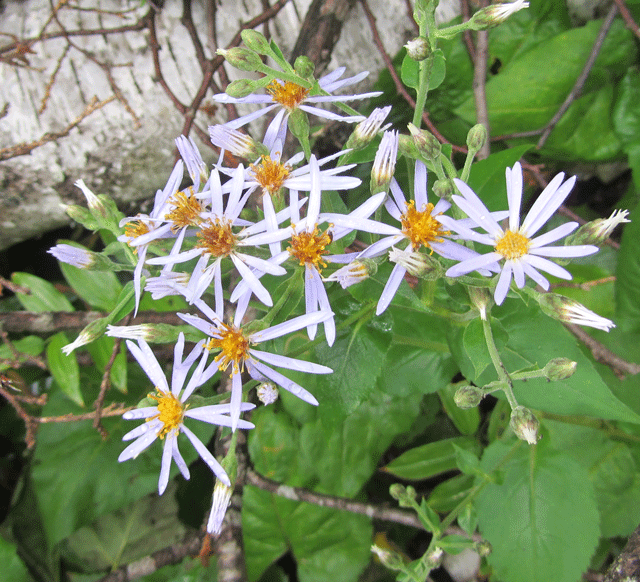
Eurybia furcata, commonly called forked aster, is an herbaceous perennial in the family Asteraceae. It is native primarily to the Great Lakes region and the Ozark Mountains in the United States. It is uncommon throughout its range, and occurs in the states of Michigan and Wisconsin in the north, south through Nebraska, Illinois, Iowa, and Indiana, and into Missouri and Arkansas. The species is intolerant of shade and is typically found on rocky, north-facing slopes, especially those composed of limestone, dolomite, or sandstone. It can also be found in seeps on bluffs, in moist woods along streams, and occasionally in disturbed sites. It is included in the Center for Plant Conservation's National Collection of Endangered Plants.
- Family
- Asteraceae
How to use it
The forked aster is included in the National Collection of Endangered Plants, highlighting its ecological importance. It thrives in rocky, well-drained soils and can be used in native plant gardens to support local wildlife, especially pollinators that are attracted to its flowers.
Sources: en.wikipedia.org
Ecology
How it lives
- Propagated by
- Seed
Full detailsevery field on the record, to copy
- Name
- Eurybia furcata
- Slug
- eurybia-furcata
- Kingdom
- Plantae
- Family
- Asteraceae
- Genus
- Eurybia
- Species
- furcata
- Wikidata QID
- Q5413949
- Propagule type
- seed
- Container suitable
- No
- Indoor suitable
- No
- OSSI pledged
- No
- Hazard level
- 1
- Data completeness
- 43
Generated sections & citations
summarywikipedia
fun_facts_kidsllm_openai · confidence 0.80
- wikidata (common_name)
- wikipedia (description.summary) — https://en.wikipedia.org/wiki/Eurybia_furcata
fun_facts_adultllm_openai · confidence 0.80
- sprigloom (taxonomy)
- wikipedia (description.summary) — https://en.wikipedia.org/wiki/Eurybia_furcata
how_to_usellm_openai · confidence 0.80
- wikipedia (description.summary) — https://en.wikipedia.org/wiki/Eurybia_furcata