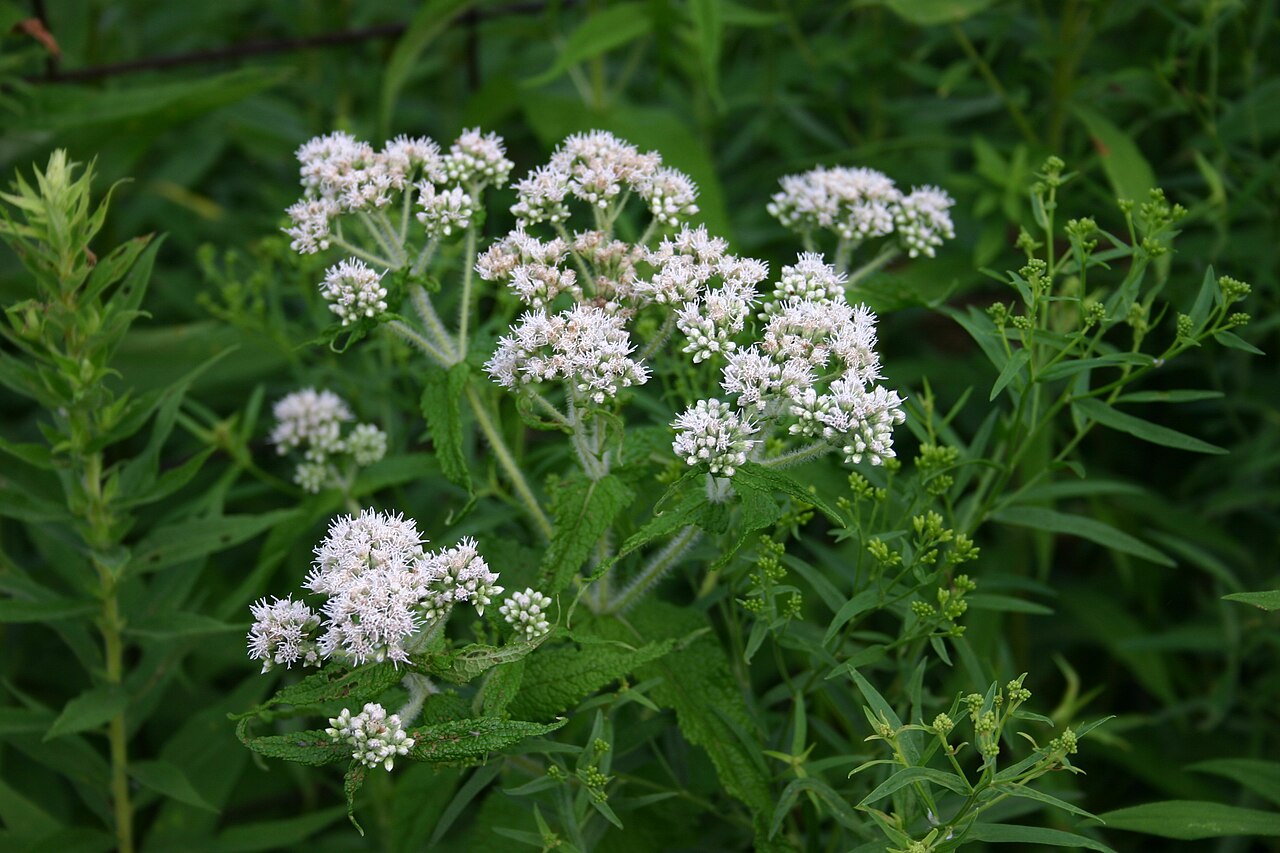
Common boneset or just boneset
Eupatorium perfoliatum
The story
Common boneset has a rich cultural history, particularly among Native Americans who introduced it to early American colonists. They used it to treat fevers by promoting heavy sweating, a practice that was later adopted by African-American communities in the southern United States. The plant's name, 'boneset,' reflects its historical use in treating dengue fever, known as 'break-bone fever,' showcasing how plants have played a vital role in traditional medicine.
Sources: en.wikipedia.org
- Family
- Asteraceae
How to use it
Common boneset is primarily used in herbal medicine as a diaphoretic, helping to induce sweating and alleviate fevers. It is important to approach its use with caution and consult with a healthcare professional, as its effectiveness and safety can vary based on individual health conditions.
Sources: en.wikipedia.org
Gardening tip
When planting common boneset, make sure to choose a spot in your garden that stays moist and has plenty of sunlight. This plant thrives in wet areas, so consider planting it near a pond or in a rain garden to provide the right conditions for growth.
Sources: en.wikipedia.org
In the kitchen
Common boneset is not eaten by humans. Instead, it has been traditionally used in herbal medicine for its properties to induce sweating and help with fevers. Always consult with a healthcare provider before using any plant for medicinal purposes.
Sources: en.wikipedia.org
About
Eupatorium perfoliatum, known as common boneset or just boneset, is a North American perennial plant in the family Asteraceae. It is a common native to the Eastern United States and Canada, widespread from Nova Scotia to Florida, west as far as Texas, Nebraska, the Dakotas, and Manitoba. It is also called agueweed, feverwort, or sweating-plant. In herbal medicine, the plant is a diaphoretic, or an agent to cause sweating. It was introduced to American colonists by natives who used the plant for breaking fevers by means of heavy sweating, and commonly used to treat fever by the African-American population of the southern United States. The name "boneset" comes from the use of the plant to treat dengue fever, which is also called "break-bone fever." It is nearly always found in low, wet areas.
Ecology
How it lives
- Propagated by
- Seed
Full detailsevery field on the record, to copy
- Name
- Eupatorium perfoliatum
- Slug
- eupatorium-perfoliatum
- Kingdom
- Plantae
- Family
- Asteraceae
- Genus
- Eupatorium
- Species
- perfoliatum
- Wikidata QID
- Q683940
- Propagule type
- seed
- Container suitable
- No
- Indoor suitable
- No
- OSSI pledged
- No
- Hazard level
- 1
- Data completeness
- 43
Generated sections & citations
summarywikipedia
fun_facts_kidsllm_openai · confidence 0.90
- wikidata (common_name)
- wikipedia (description.summary) — https://en.wikipedia.org/wiki/Eupatorium_perfoliatum
fun_facts_adultllm_openai · confidence 0.90
- sprigloom (taxonomy)
- sprigloom (taxonomy)
- sprigloom (taxonomy)
- wikipedia (description.summary) — https://en.wikipedia.org/wiki/Eupatorium_perfoliatum
cookingllm_openai · confidence 0.90
- wikipedia (description.summary) — https://en.wikipedia.org/wiki/Eupatorium_perfoliatum
storyllm_openai · confidence 0.90
- wikipedia (description.summary) — https://en.wikipedia.org/wiki/Eupatorium_perfoliatum
how_to_usellm_openai · confidence 0.90
- wikipedia (description.summary) — https://en.wikipedia.org/wiki/Eupatorium_perfoliatum
gardening_tipllm_openai · confidence 0.90
- wikipedia (description.summary) — https://en.wikipedia.org/wiki/Eupatorium_perfoliatum