Erythrina edulis
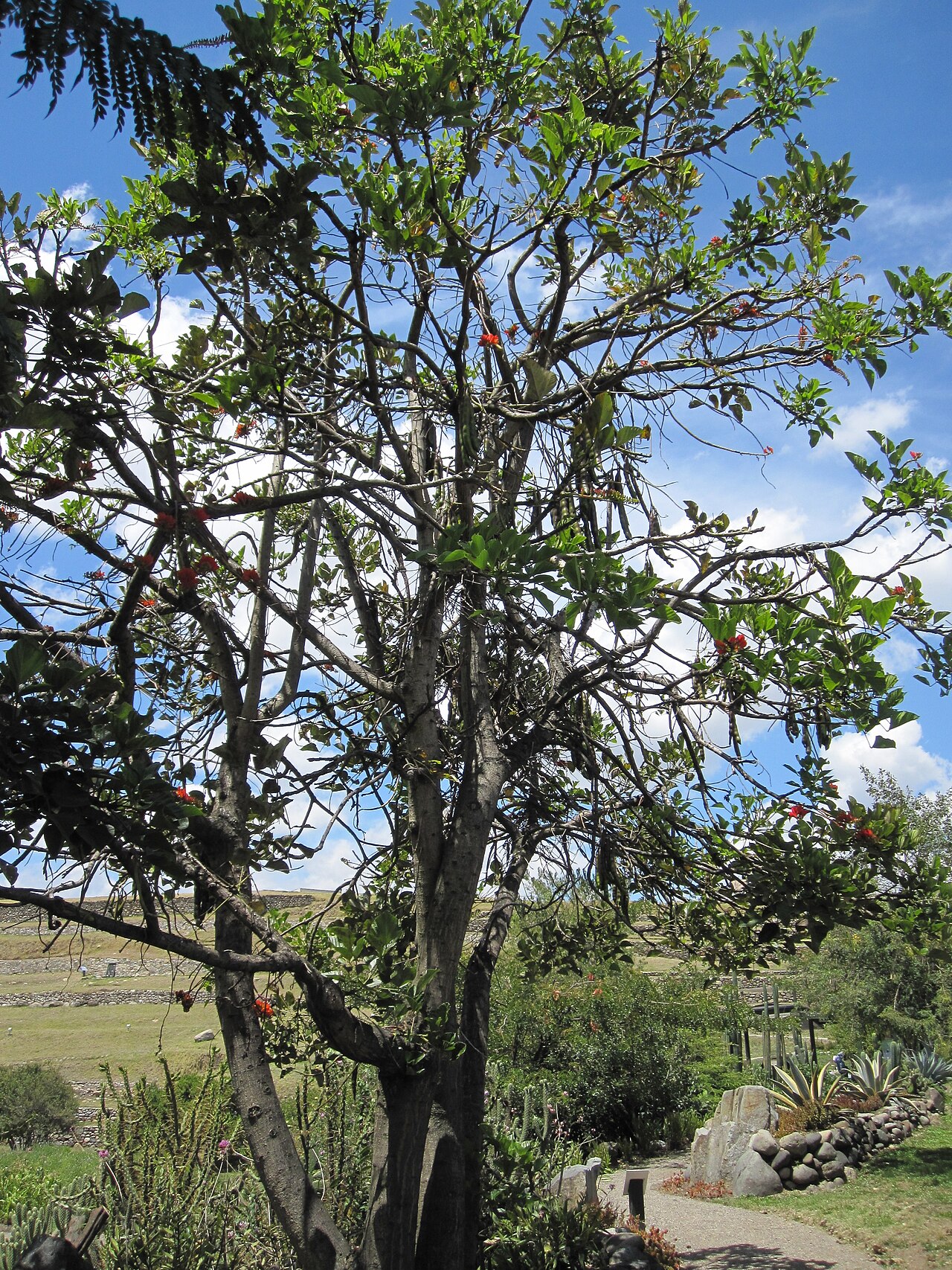
The story
In the high Andes, spanning from western Venezuela all the way to southern Bolivia, this tree has woven itself into local cultures under many names. In Colombia, people call it 'chachafruto' or 'balú,' while in Ecuador it is known as 'guato.' In Bolivia, Peru, and Northwest Argentina, locals recognize it as 'psonay' or 'pajuro.' Despite these deep regional roots and its many names, this bean-producing tree is still not widely cultivated.
Sources: en.wikipedia.org
- Family
- Fabaceae
How to use it
This versatile tree serves multiple agricultural and practical purposes. It is a nitrogen-fixing species that can be planted as a living fence. Additionally, its protein-rich beans provide valuable nutrition for humans and animals, while its leaves and branches can be harvested to use as animal fodder.
Sources: en.wikipedia.org
Gardening tip
When planting Erythrina edulis, ensure that it is placed in a sunny spot to thrive and maximize its nitrogen-fixing benefits.
Sources: en.wikipedia.org
In the kitchen
The beans produced by basul are protein-rich and can be used for human or animal nutrition. They are covered in pods and can be cooked in various dishes. However, it's important to note that the tree is not commonly cultivated, so finding these beans might be a challenge!
Sources: en.wikipedia.org
About
Erythrina edulis (basul) is a nitrogen fixing tree that is native to the Andean region from western Venezuela to southern Bolivia. Nowadays it is known in Venezuela as "frijol mompás", in Bolivia, Peru and Northwest Argentina as "psonay", "pajuro", "sachaporoto del basul" or "poroto del sacha", in Colombia as "chachafruto", "balú", "baluy" or "sachaporoto" and in Ecuador as "guato". Although it is widely known, it is not commonly cultivated. Future research is needed, especially in agroforestry. Basul is a legume and so it produces protein-rich beans covered in pods which can be used for human or animal nutrition. The leaves and branches can be used as fodder. Besides the agricultural aspects, Erythrina edulis can also be used as a fence plant.
Ecology
How it lives
- Propagated by
- Seed
Full detailsevery field on the record, to copy
- Name
- Erythrina edulis
- Slug
- erythrina-edulis
- Kingdom
- Plantae
- Family
- Fabaceae
- Genus
- Erythrina
- Species
- edulis
- Wikidata QID
- Q5234520
- Propagule type
- seed
- Container suitable
- No
- Indoor suitable
- No
- OSSI pledged
- No
- Hazard level
- 1
- Data completeness
- 43
Generated sections & citations
summarywikipedia
cookingllm_openai · confidence 0.80
- wikipedia (description.summary) — https://en.wikipedia.org/wiki/Erythrina_edulis
fun_facts_adultllm_gemini · confidence 0.00
- wikipedia (description.summary) — https://en.wikipedia.org/wiki/Erythrina_edulis
how_to_usellm_gemini · confidence 0.00
- wikipedia (description.summary) — https://en.wikipedia.org/wiki/Erythrina_edulis
fun_facts_kidsllm_gemini · confidence 0.00
- sprigloom (taxonomy)
- wikipedia (description.summary) — https://en.wikipedia.org/wiki/Erythrina_edulis
storyllm_gemini · confidence 0.00
- wikipedia (description.summary) — https://en.wikipedia.org/wiki/Erythrina_edulis
gardening_tipllm_openai · confidence 0.00
- wikipedia (description.summary) — https://en.wikipedia.org/wiki/Erythrina_edulis