Cyathus helenae
Foraging: Never eat a wild mushroom on a photo or an app’s word. Many deadly species look like edible ones.
About
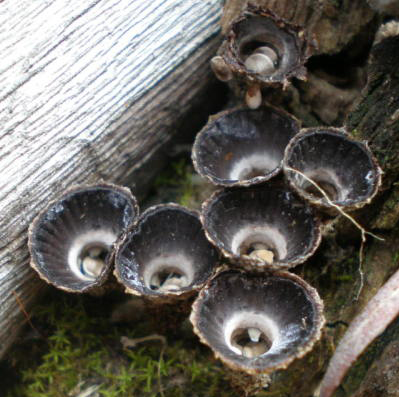
Cyathus helenae or Helena's bird's nest is a species of fungus in the genus Cyathus, family Nidulariaceae. Like other members of the Nidulariaceae, C. helenae resembles a tiny bird's nest filled with 'eggs'—spore-containing structures known as peridioles. It was initially described by mycologist Harold Brodie in 1966, who found it growing on mountain scree in Alberta, Canada. C. helenae's life cycle allows it to reproduce both sexually and asexually. One of the smaller species of Cyathus, C. helenae produces
- Family
- Agaricaceae
How to use it
This fungus is primarily of interest for its ecological role and unique chemical compounds. The cyathins produced by Helena's bird's nest could have potential applications in research, particularly in the study of natural products and their effects.
Sources: en.wikipedia.org, en.wikipedia.org
Full detailsevery field on the record, to copy
- Name
- Cyathus helenae
- Slug
- cyathus-helenae
- Kingdom
- Fungi
- Family
- Agaricaceae
- Genus
- Cyathus
- Species
- helenae
- Wikidata QID
- Q5197647
- Propagule type
- seed
- Container suitable
- No
- Indoor suitable
- No
- OSSI pledged
- No
- Hazard level
- 1
- Data completeness
- 43
Generated sections & citations
summaryinaturalist
fun_facts_kidsllm_openai · confidence 0.80
- inaturalist (description.summary) — https://en.wikipedia.org/wiki/Cyathus helenae
fun_facts_adultllm_openai · confidence 0.80
- inaturalist (description.summary) — https://en.wikipedia.org/wiki/Cyathus helenae
- wikipedia (description.summary) — https://en.wikipedia.org/wiki/Cyathus_helenae
how_to_usellm_openai · confidence 0.80
- inaturalist (description.summary) — https://en.wikipedia.org/wiki/Cyathus helenae
- wikipedia (description.summary) — https://en.wikipedia.org/wiki/Cyathus_helenae