Candida albicans
Foraging: Never eat a wild mushroom on a photo or an app’s word. Many deadly species look like edible ones.
About
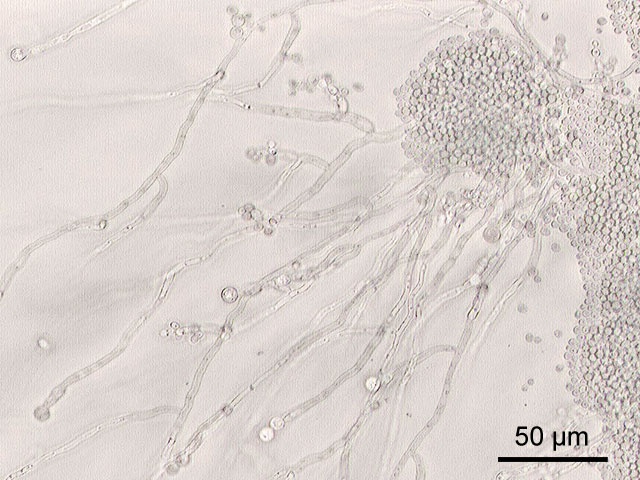
Candida albicans is an opportunistic pathogenic yeast that is a common member of the human gut flora. It can also survive outside the human body. It is detected in the gastrointestinal tract and mouth in 40–60% of healthy adults. It is usually a commensal organism, but it can become pathogenic in immunocompromised individuals under a variety of conditions. It is one of the few species of the genus Candida that cause the human infection candidiasis, which results from an overgrowth of the fungus. Candidiasis is, for example, often observed in HIV-infected patients. C. albicans is the most common fungal species isolated from biofilms either formed on (permanent) implanted medical devices or on human tissue. C. albicans, C. tropicalis, C. parapsilosis, and C. glabrata are together responsible for 50–90% of all cases of candidiasis in humans. A mortality rate of 40% has been reported for patients with systemic candidiasis due to C. albicans. By one estimate, invasive candidiasis contracted in a hospital causes 2,800 to 11,200 deaths yearly in the US.
- Family
- Debaryomycetaceae
Full detailsevery field on the record, to copy
- Name
- Candida albicans
- Slug
- candida-albicans
- Kingdom
- Fungi
- Family
- Debaryomycetaceae
- Genus
- Candida
- Species
- albicans
- Wikidata QID
- Q310443
- Propagule type
- seed
- Container suitable
- No
- Indoor suitable
- No
- OSSI pledged
- No
- Hazard level
- 1
- Data completeness
- 43
Generated sections & citations
summarywikipedia
fun_facts_adultllm_openai · confidence 0.70
- wikipedia (description.summary) — https://en.wikipedia.org/wiki/Candida_albicans