Amanita nothofagi
Foraging: Never eat a wild mushroom on a photo or an app’s word. Many deadly species look like edible ones.
About
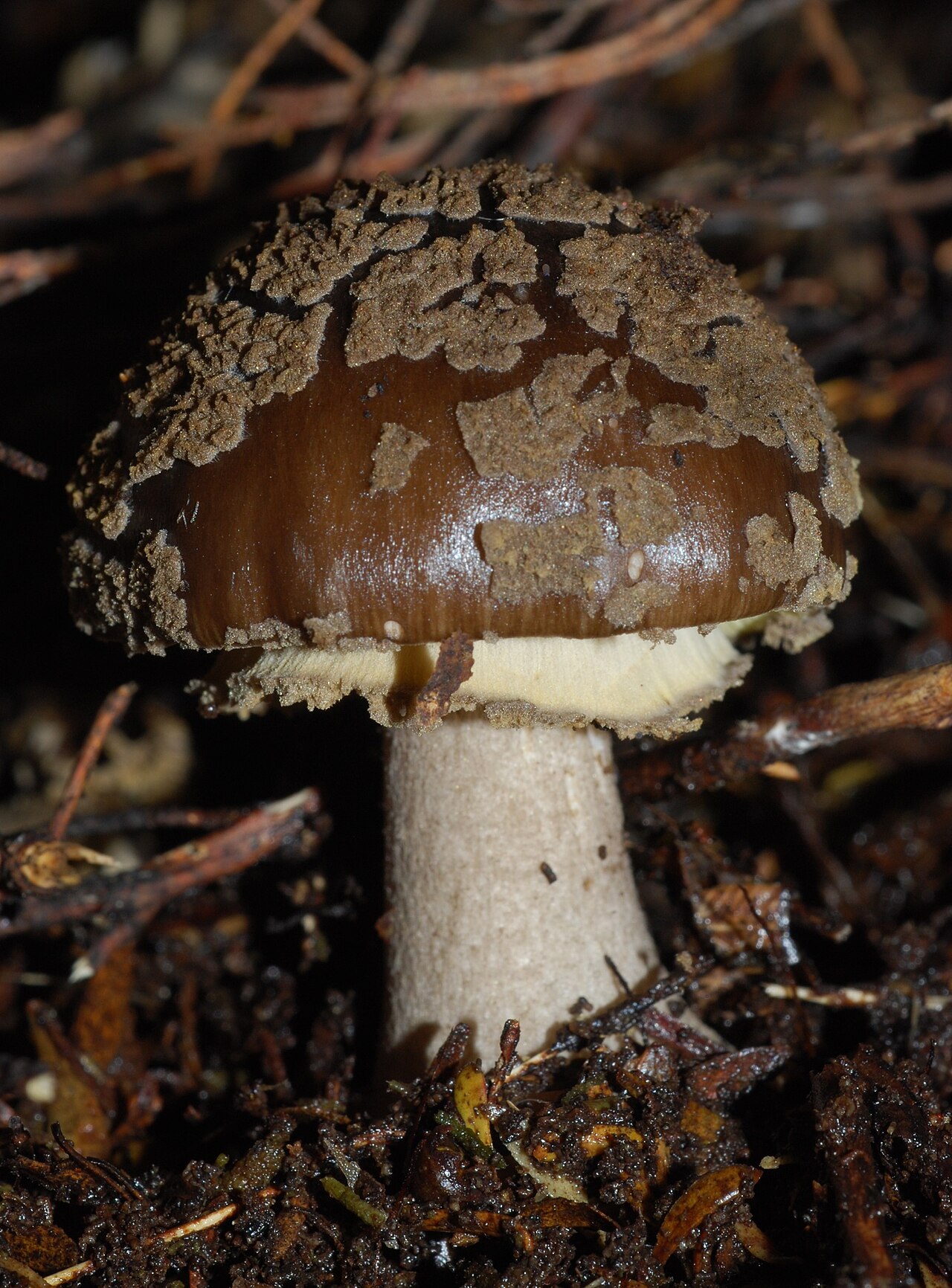
Amanita nothofagi is a species of fungus in the family Amanitaceae. Endemic to New Zealand, the species was first described by mycologist Greta Stevenson in 1962. The fruit bodies have dark brown caps that are up to 13 cm (5.1 in) in diameter and covered with patches of soft greyish-brown scales or warts. The gills underneath the cap are crowded together, free from attachment to the stem, and white, becoming tinged with yellow in age. The stem of the mushroom is 4–14 cm (1.6–5.5 in) long by 0.5–2.5 cm (0.2–1.0 in) thick, and has a ring. The spore print is white, and individual spores are spherical to ellipsoid, measuring 7.5–9 by 7.5–9 micrometres. The mushroom may be confused with another New Zealand species, A. australis, but can be distinguished by certain characteristics. Amanita nothofagi is a mycorrhizal species, and grows in association with native New Zealand trees such as southern beech.
- Family
- Amanitaceae
Full detailsevery field on the record, to copy
- Name
- Amanita nothofagi
- Slug
- amanita-nothofagi
- Kingdom
- Fungi
- Family
- Amanitaceae
- Genus
- Amanita
- Species
- nothofagi
- Wikidata QID
- Q4739880
- Propagule type
- seed
- Container suitable
- No
- Indoor suitable
- No
- OSSI pledged
- No
- Hazard level
- 1
- Data completeness
- 43
Generated sections & citations
summarywikipedia